
Best AI Demo Video Makers for SaaS in 2026
Compare the best AI demo video generators for SaaS in 2026, including tools for polished videos, interactive demos, and avatar-led content.
TL;DR
Screen recording to video
- Clueso works best for turning real screen recordings into polished SaaS demos with AI scripts, voiceovers, and minimal editing.
- Guidde suits quick video walkthroughs paired with step-by-step documentation.
- Descript gives creators detailed, text-based control over recorded footage.
- Camtasia suits desktop users who prefer traditional timeline editing and local production.
Interactive demo platforms
- Supademo works well for quickly captured click-through demos.
- Arcade creates polished, embeddable product tours for marketing pages.
- Storylane supports personalized sales demos with guided and branching paths.
Avatar-led generators
- Synthesia fits multilingual, presenter-led training and explainers.
- HeyGen suits localized avatar videos that prioritize realistic presenters and dubbing.
Why SaaS teams need different demo video tools for different jobs
A search for a demo video maker in 2026 can lead to three product categories that produce different deliverables. Choosing the category first prevents you from spending time comparing tools that cannot create the format you need.
Screen-recording-to-video tools turn a real product workflow into a finished, linear video. They suit product marketing, onboarding, and customer education when viewers need to see the actual software in use. Tools like Clueso automate end-to-end production and editorial work while some tools only focus on providing greater manual control like Camtasia.
Then there are interactive demo platforms such as Arcade and Storylane that create click-through product experiences with hotspots, guided paths, or branching. They work well when prospects need to explore a product themselves. These platforms serve a different purpose from a rendered SaaS demo video that you can publish across marketing and training channels.
A third category is avatar-led generators such as Synthesia and HeyGen that create presenter-style videos from scripts. They fit multilingual explainers and training content, especially when a human-like presenter matters more than an authentic product workflow. Product footage can appear within these videos, but the avatar remains the main presentation layer.
Each product below is evaluated on the quality of its finished output and the work required to produce it. The production assessment covers speed, editing effort, branding, and script and voiceover quality. Buyer fit also depends on interactivity, localization, collaboration, export options, and pricing. Maintenance receives separate attention because SaaS interface changes can quickly make recorded demos inaccurate.
Clueso
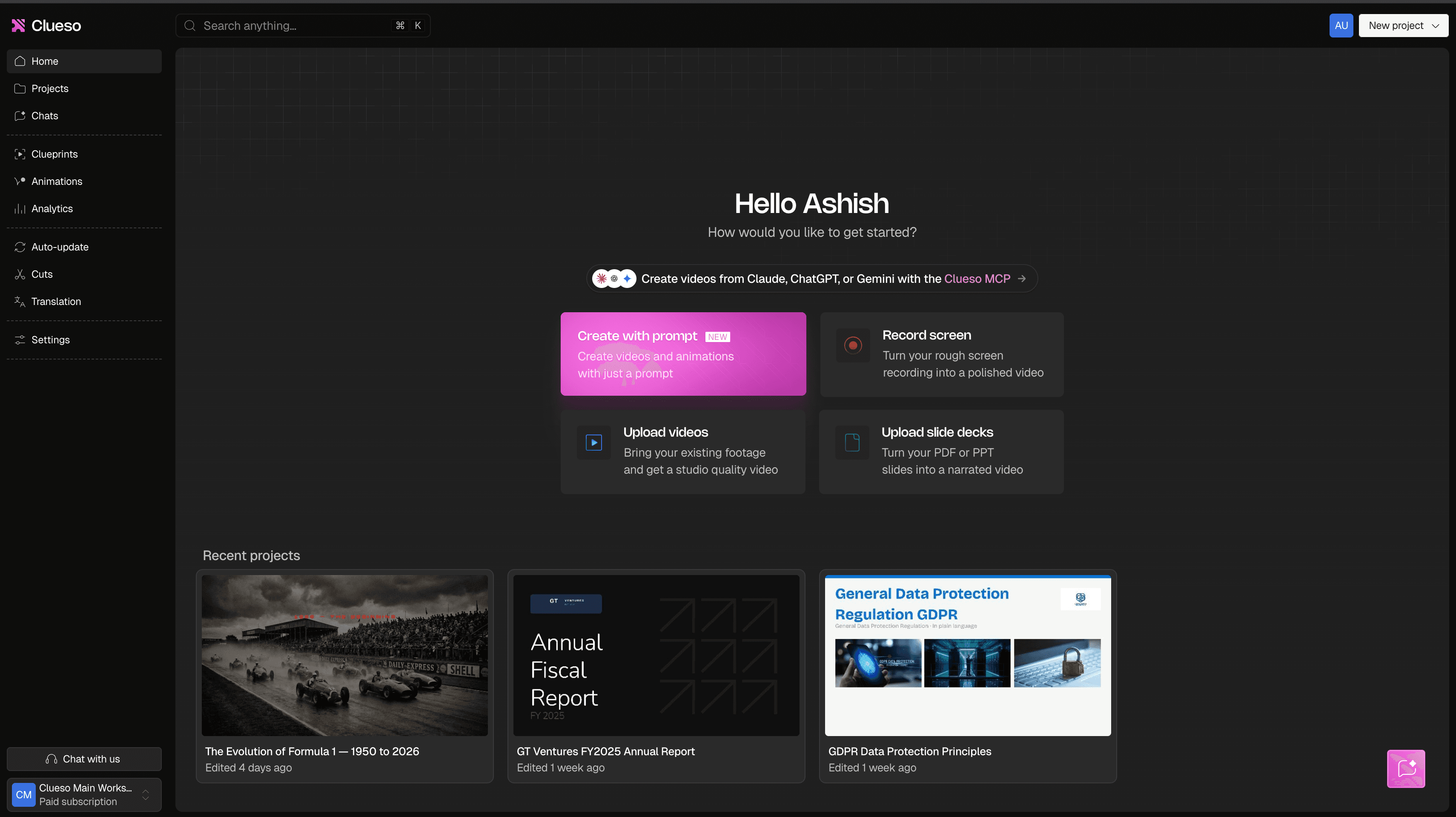
Best for: Clueso is the best choice for SaaS teams that want to turn real product recordings into polished, branded demo videos with minimal manual editing. Its recording-first workflow suits product marketing, sales enablement, and customer education content that needs to show the actual software.
What it is: Clueso converts a raw screen recording into an edited software demo video. Its AI improves the narration script, generates a natural-sounding voiceover, adds captions, and applies visual effects such as automatic zooms. You can start by demonstrating the product normally instead of writing a complete script or planning every edit before recording.
Pros:
- Clueso reduces scriptwriting and narration work. The platform uses the recorded workflow to draft a clearer script, then turns that script into an AI voiceover. You can produce professional narration without recording multiple takes or hiring a voice actor.
- Clueprints give recurring demos a reusable structure and visual identity. You can standardize elements such as introductions, branding, and motion graphics, which helps separate creators produce consistent videos without rebuilding the format each time.
- Clueso protects sensitive information inside recorded screens. You can blur confidential content or replace real names, account details, and other private information with synthetic data. Product marketers can record realistic workflows without exposing customer or internal data.
- Clueso helps you maintain demos after the interface changes. The platform monitors changes in your product codebase and recommends updates to affected content. You can patch the outdated clip instead of recording the full demo again, and the revised video updates across its existing embeds and links.
- Clueso can translate screen-recorded demos for international audiences. You can create dubbed versions or change subtitles while preserving the original audio when a full voiceover translation would add unnecessary cost.
Cons:
- Clueso does not yet provide branching paths, quizzes, assessments, or click-through product exploration. Arcade, and Storylane fit better when prospects need to interact with a guided replica instead of watching a finished video.
- Clueso centers the real product interface rather than an on-screen presenter. You can use motion graphics and animation to highlight parts of your products but Synthesia or HeyGen may suit presenter-led videos better when a digital avatar needs to carry most of the explanation.
Pricing: Clueso offers a free plan. Its Solo plan starts at $40 per month when billed annually, while enterprise pricing depends on usage and organizational requirements.
Guidde
Best for Guidde best suits SaaS teams that want to capture a workflow and turn it into step-based instructional content.
What it is Guidde is a screen-recording-to-video tool with roots in AI-assisted documentation. Its documentation-first approach fits onboarding, support, and internal walkthroughs where viewers need to follow a defined sequence. Clueso focuses more directly on turning raw recordings into polished, branded SaaS demo videos and accompanying SOPs.
Pros Guidde earns credit when a walkthrough must teach a repeatable process rather than serve only as a marketing asset. Its step-based format can make procedural content easier to scan and follow.
Cons The supplied research does not verify Guidde’s current editing controls, branding options, voice quality, localization, exports, collaboration features, or maintenance workflow. Buyers should test those areas against their production requirements before choosing it over Clueso or another screen-recording tool.
Pricing: Guidde offers a free plan with up to 25 how-to videos. The Pro plan costs $19 per creator per month with annual billing, or $29 with monthly billing. Business costs $39 per creator per month annually, or $59 monthly. Enterprise pricing is custom. Guidde also offers a seven-day Business trial without requiring a credit card.
Supademo
Best for
Supademo suits SaaS teams that need prospects or customers to click through a guided product experience. Sales outreach, help centers, and website embeds fit its interactive format well.
What it is
Supademo captures a product workflow as a sequence of interactive steps. You can add annotations, calls to action, and branching paths, then share the demo through a link or embed. Viewers control the pace instead of watching a fixed software demo video.
Pros
Quick capture and lightweight sharing make Supademo practical for producing interactive walkthroughs without engineering help. Branching lets viewers follow different routes based on their role or goal. Supademo also supports blurring or redacting sensitive screen content. Clueso offers privacy controls for recorded workflows as well, so data protection alone should not decide between them.
Cons
Supademo works best when viewer interaction drives the experience. Teams that need a polished, narrated video for launch pages, social posts, or customer education may prefer Clueso’s screen-recording-to-video workflow. Supademo’s annotations and branching options can also require more planning as a walkthrough expands.
Pricing
Supademo offers a free plan for one creator with five guided demos and 50 video recordings. Scale costs $50 per creator per month, or $38 per month with annual billing. Growth costs $450 monthly, or $350 per month annually, and includes five creators. Enterprise pricing is custom and starts at 10 creators.
Arcade
Best for: Arcade works best for SaaS marketing and sales teams that want polished, embeddable product tours on websites or landing pages.
What it is: Arcade turns captured product interactions into guided, click-through demos. Viewers explore the interface by advancing through hotspots and prompts, which gives them more control than a rendered software demo video.
Pros: Arcade’s main strength comes from its presentation and embed experience. You can place an interactive tour on a product page and let prospects explore a workflow without booking a live demonstration. The format suits feature launches, sales follow-ups, and self-guided product education.
Cons: Arcade focuses on interactive exploration rather than finished video production. If you need a narrated video file built from a real screen recording, an AI demo video generator such as Clueso provides a more direct workflow. Arcade may also require ongoing tour updates when interface changes affect captured screens or click targets.
Pricing: Arcade offers a free plan with one published demo, one published video, and 200 AI credits per month. Growth costs $50 per seat per month and includes unlimited published demos and videos plus 800 monthly AI credits. Annual billing receives a 15% discount. Enterprise pricing is custom.
Storylane
Best for
Storylane fits sales teams that need personalized, interactive demos with branching paths for different buyer needs.
What it is
Storylane creates guided product experiences that prospects can explore without entering a live SaaS account. Sales reps can tailor demo environments to an account and direct each prospect through a relevant path. Compared with Supademo’s quick click-through capture, Storylane places more emphasis on sales personalization. Arcade focuses more heavily on polished product tours for marketing pages.
Pros
Storylane lets buyers explore workflows at their own pace, while branching can adapt the experience to different roles or use cases. Personalized demo environments also help sales reps present relevant screens without configuring a live account for every prospect.
Cons
Storylane does not primarily produce a finished, narrated software demo video. SaaS teams that need a polished video file for onboarding, customer education, or social channels will get a closer fit from a screen-recording-to-video tool such as Clueso. Interactive demos also require upkeep when the interface or workflow changes.
Pricing
Storylane offers a free plan with one seat and one published demo. Starter costs $50 per month with monthly billing, or $40 per month annually, with a two-seat minimum. Growth costs $625 monthly or $500 per month annually for five seats. Premium costs $1,500 monthly or $1,200 per month annually for 10 seats. Enterprise pricing is custom.
Synthesia
Best for: Presenter-led SaaS explainers and multilingual training videos where an AI avatar delivers a prepared script.
What it is: Synthesia turns written scripts into videos presented by AI avatars. You select an avatar and voice, add visual elements, and generate localized versions without recording a human presenter. The script-first workflow suits feature announcements, training modules, and high-level product explainers.
Pros: Synthesia reduces the work involved in filming presenters and rerecording localized versions. Its avatar format also gives distributed teams a consistent presenter across a series of videos. You can combine narration with screenshots or product footage when the interface needs supporting context.
Cons: Synthesia works less naturally for demos built around an authentic product workflow. A SaaS demo often needs precise cursor movement, interface timing, zooms, and narration tied directly to actions on screen. Building that sequence around a scripted avatar can require more assembly than starting with the real screen recording. Clueso fits that recording-led workflow better, while Synthesia fits content where the presenter carries the explanation.
Pricing: Synthesia offers a free Basic plan with up to 10 video minutes per month. Starter costs €19 monthly, or €12 per month with annual billing, and includes 120 video minutes per year on the annual plan. Creator costs €79 monthly, or €49 per month annually, with 360 annual video minutes. Enterprise pricing is custom.
HeyGen
Best for: HeyGen suits SaaS teams that need realistic avatar presenters, multilingual narration, and localized versions of the same demo.
What it is: HeyGen creates presenter-led videos from scripts and supports dubbing existing footage into additional languages. You can combine an avatar with product screenshots or screen recordings, but the workflow starts with the presenter and script rather than an authentic product walkthrough.
Pros: HeyGen offers lifelike avatars and deep localization options. Its dubbing tools help you reuse a finished demo across regions without recording each voice track again. Compared with Synthesia, HeyGen deserves particular consideration when avatar realism and translated delivery carry the most weight.
Cons: HeyGen requires more preparation when the product interface must drive the story. You still need to capture, arrange, and maintain the UI footage as the software changes. A screen-recording-to-video tool such as Clueso fits better when you want AI to build the script and voiceover around a recorded workflow. HeyGen also lacks the branching paths and click-through exploration offered by interactive demo platforms.
Pricing: HeyGen offers a free plan with three videos per month. Creator costs $29 per month, or $24 per month with annual billing, and includes 600 credits. Pro starts at $49 per month with 1,000 credits. Business costs $149 per month plus $20 per additional seat and includes 1,500 credits. Enterprise pricing is custom.
Descript
Best for
SaaS teams that want hands-on creative control over recorded demo footage and prefer editing through both a transcript and a traditional timeline.
What it is
Descript combines screen recording, transcript-based editing, and timeline video editing. You can revise a recording by deleting words from its transcript, then adjust pacing, captions, audio, layouts, and visual elements in the timeline. AI features can remove filler words, improve recorded audio, and help revise narration.
Pros
Descript gives you more control over timing and presentation than an automated product demo video maker. Transcript editing makes spoken demos easier to revise, especially when a presenter records extra takes or makes verbal mistakes. Its broader audio and video tools also suit teams that produce podcasts, interviews, and social clips alongside software demos.
Cons
Descript requires more production work than Clueso for a polished SaaS demo video. You still need to decide where to zoom, how to frame the interface, when to add visual emphasis, and how to organize the final narrative. Descript also treats your recording as general video footage rather than automatically turning a real product workflow into a structured demo and related SOP.
Pricing
Descript offers a free plan with one media hour per month. With annual billing, Hobbyist costs $16 per person per month, Creator costs $24, and Business costs $50. Monthly prices are $24, $35, and $65 respectively. Enterprise pricing is custom. Media hours and AI credits increase by tier.
Camtasia
Best for
Camtasia suits SaaS teams that want desktop recording, local media control, and hands-on editing. It also appeals to buyers who prefer a perpetual license over another recurring software subscription.
What it is
Camtasia combines screen recording with a traditional timeline editor. You record a product workflow, then manually arrange clips, remove mistakes, add callouts, adjust audio, and export a finished software demo video.
Pros
The desktop editor gives you precise control over timing, cursor movement, annotations, transitions, and audio. Local editing can also suit companies that do not want every recording processed through a browser-based service.
Cons
Camtasia requires the most manual effort among the tools in this comparison. You handle more of the scripting, narration, visual cleanup, and timeline work yourself. SaaS teams producing frequent demos may find that workload slower than an AI-native screen-recording workflow such as Clueso.
Camtasia also lacks the branching and guided exploration found in Storylane, Arcade, and Supademo. Its finished videos support passive viewing rather than click-through product exploration.
Pricing
TechSmith offers Camtasia through paid desktop licensing, with plan and perpetual-license availability varying by edition. Check the current terms before buying if one-time-purchase pricing drives your decision.
How the tools compare
The ranking reflects each product’s fit for SaaS demo work rather than treating different tool categories as interchangeable. NR means the supplied research did not verify a current rating or price.
Rank | Product | Category | Starting price | Best-fit user | Standout strength | Interactivity | Localization | Maintenance |
|---|---|---|---|---|---|---|---|---|
1 | Clueso | Screen recording to video | Free plan, paid from $40 monthly billed annually | SaaS product and education teams | Polished videos with scripts, voiceovers, branding, and update detection | No | High | Automated and easy to maintain |
2 | Guidde | Screen recording to video | Free; Pro from $19 per creator monthly, billed annually | Internal enablement teams | AI-assisted step guides | Low | High on Enterprise | Version history and review controls |
3 | Supademo | Interactive demo | Free; Scale from $38 per creator monthly, billed annually | Teams sharing quick product walkthroughs | Fast click-through capture | High | High | Demo versioning on Growth |
4 | Arcade | Interactive demo | Free; Growth from $50 per seat monthly | Marketing teams embedding tours | Polished website embeds | High | High | Version history on Enterprise |
5 | Storylane | Interactive demo | Free; Starter from $40 monthly, billed annually, two-seat minimum | Sales teams | Branching and personalized demo paths | High | High on Premium | Manual |
6 | Synthesia | Avatar-led video | Free; Starter from €12 monthly, billed annually | Multilingual training teams | Script-based avatar presenters | Medium | High | Smart embed updates |
7 | HeyGen | Avatar-led video | Free; Creator from $24 monthly, billed annually | Teams localizing presenter videos | Realistic avatars and dubbing | Medium on Business | High | Manual |
8 | Descript | AI video editor | Free; Hobbyist from $16 per person monthly, billed annually | Creators wanting editing control | Text-based editing | No | High on Business | Manual |
9 | Camtasia | Desktop video editor | Verify current price | Users preferring desktop production | Detailed timeline control | No | NR | Manual |
Choosing the right category for your demo
Choose the category based on what your audience should receive and do.
- If you need a polished product marketing asset, choose a screen-recording-to-video tool. Clueso turns a real software workflow into a branded video with an enhanced script, AI voiceover, and automated visual editing.
- If buyers should explore the product and choose their own path, pick an interactive demo platform. Storylane supports branching and personalized sales tours, while Arcade and Supademo suit embeddable click-through experiences.
- If a presenter needs to deliver the same message across languages, consider an avatar-led generator. Synthesia and HeyGen work well for multilingual training, but they suit presenter-led explanations better than authentic product walkthroughs.
- If you need a quick internal walkthrough, prioritize capture speed and easy updates. Guidde suits lightweight step documentation, while Clueso fits polished onboarding videos and automatically generated SOPs.
- If you want detailed control over every edit, choose Descript or Camtasia. Both require more hands-on production than an automated screen-recording workflow, but they give editors more control over timing and media.
Some SaaS teams reasonably use two categories together. You might use Clueso for a polished demo video on your website and Storylane for an interactive sales tour that lets prospects explore different paths. Each asset then serves a separate stage of the buying process.
Why Clueso leads for SaaS demo videos
Clueso reduces the maintenance work that usually follows every product release. It monitors changes in your product codebase and recommends updates when existing demos become stale. You can patch the affected clip instead of recording the full demo again, and the revised video updates everywhere it is embedded.
Clueprints give each demo a reusable branded structure, which helps you produce consistent videos across products and campaigns. Clueso can also translate screen-recorded demos with AI voiceovers or create subtitles while preserving the original audio. You can produce localized variants without hiring voice talent for every language.
These capabilities make Clueso a strong fit for SaaS companies that publish demos frequently and need them to remain accurate after release. Interactive platforms remain better for branching tours, but Clueso handles the recurring work behind polished video assets. Try Clueso to create and maintain your next SaaS demo video.
FAQs
- What separates an AI demo video generator from an interactive demo platform? An AI demo video generator produces a finished video for sharing or embedding. An interactive platform lets viewers click through screens, choose paths, and explore the product themselves.
- Can one tool create both a polished video and an interactive tour? Some tools offer limited overlap, but most specialize. You might use Clueso for a polished SaaS demo video and Storylane, Arcade, or Supademo for a click-through tour.
- How do these tools protect sensitive data shown on screen? Features vary, so check whether a tool supports blurring, redaction, or data replacement. Clueso can blur sensitive screen content and replace real information with synthetic data.
- Do avatar tools work for showing a real product interface? Synthesia and HeyGen can place screenshots or recorded footage beside an avatar. However, their script-first workflows suit presenter-led explainers better than detailed demonstrations of an authentic product workflow.
- How is demo video pricing typically structured? SaaS tools commonly charge monthly or annually by creator seats, usage, export limits, or premium AI features. Interactive platforms may also restrict published demos, viewer analytics, or advanced branching by plan. Desktop editors such as Camtasia may offer one-time purchase options.
- Which category works best for customer education? Screen-recording-to-video tools suit reusable onboarding and training assets. Interactive platforms fit guided practice, while avatar generators fit presenter-led multilingual lessons.
Ashish Upadhyay
Senior Content Marketing Manager
Ashish is a Senior Content Marketing Manager at Clueso with 7+ years of experience across content, product, brand marketing. Now his mission is to help product and customer education teams realize the value of video-based learning. Outside of work, Ashish sketches, sings, plays the guitar, cooks, and does all things LLMs can't yet.