Descript vs Synthesia: Transcript Editing or AI Avatars

Both tools streamline the way teams create videos, but they take completely different paths.

Synthesia is built for script-to-video production with lifelike AI avatars that deliver polished training and communication content. Descript flips the model: it lets you edit video by editing text, making it perfect for podcasts, talking-head explainers, and narration-heavy content.

Backed by

Rated 4.9

on

G2.com

Backed by

Rated 4.9

on

G2.com

Backed by

Rated 4.9

on

G2.com

Clueso vs XYZ at a glance

Content Creation Capabilities

Feature

Descript

Synthesia

AI Avatars

Screen Recording

Face clones

Voice clones

Transcript Editing

AI Voiceovers

✓ (Dubbing)

Multi-Track Editing

Audio-video sync

Manual

Manual

Multi-language Translation

Professional Features

Feature
Descript
Synthesia
Custom Branding
✓ (drive-level feature)
Limited
Custom templates
❌ (template library available)

Enterprise Features

Feature
Descript
Synthesia
Security Compliance
SOC2
SOC2, ISO/IEC 42001:2023
Shared Team Workspace
Access Control by Roles
Basic

Descript vs Synthesia: Detailed Comparison

Two powerful creation tools - one built for AI presenters, the other built for transcript-led editing.

  1. Content Creation Capabilities

Descript focuses on transcript-based editing, where creators edit video by editing text. This makes it exceptionally powerful for talking-head content, podcasts, interviews, and scripted explainers. It has screen recording, multi-track editing, AI dubbing, and a very natural workflow for fine-tuning narration and pacing. Its editing model makes revisions incredibly fast, especially for narration-heavy videos.

With Synthesia, you write a script, choose from a large library of virtual presenters, and it generates polished videos ideal for training, onboarding, or announcements. It supports face clones, voice clones, AI voiceovers, and strong multilingual capabilities. While it offers basic screen recording, its true value lies in avatar-based delivery and the speed of generating presentable videos without cameras or microphones.

B. Professional Features

Descript offers flexible branding within its drive-level branding system, allowing teams to maintain visual identity across shared assets. While it doesn’t provide custom templates in the traditional sense, its template library and text-first editing approach make it easy to replicate formats, scenes, and style elements — ideal for creators producing recurring series, podcasts, or narrative videos.

Synthesia provides custom templates and basic branding controls, ensuring consistency across avatar-led videos. These templates help structure scenes, text placement, and transitions, making Synthesia especially useful for standardized training modules or corporate communication where uniformity matters.

C. Enterprise Features

Descript is SOC2-compliant as well and provides collaborative workspaces where teams can work together. Its access controls are more lightweight, hence suitable for content teams working jointly on videos. But it's less focused on heavy governance requirements. Its cloud-first environment makes it easy for distributed teams to collaborate in real time.

Synthesia stands out with SOC2 compliance and the additional ISO/IEC 42001:2023 AI governance certification, making it appealing for enterprises with strict standards for AI usage and content governance. It also supports shared workspaces and strong role-based access controls for structured collaboration.

What to Consider When Choosing Between Descript & Synthesia

1. Clueso captures real product workflows

Synthesia and Descript help you produce polished communication, but neither focuses on capturing what users actually do inside your product.

Clueso records your real screen, detects every action you take, and transforms it into a structured, step-based tutorial. While Clueso offers AI avatars and transcript editing features, it focuses on capturing the product experience exactly as it happens.

Feature
Clueso
Descript
Synthesia
Screen Recording
Basic
Basic
Step Detection
Automatic


2. AI-enhanced editing removes manual video work

Descript simplifies narration, and Synthesia automates avatar delivery — but neither automates editing for product tutorials.

Clueso uses AI to rewrite scripts, generate AI voiceovers, remove filler words, automatically apply zooms, spotlights, callouts, audio cleanup, and 1-click translations. There’s no timeline, no layers, no manual trimming. It produces polished instructional content with minimal effort.

Feature
Clueso
Descript
Synthesia
Video Editing
Automated
Manual
AI-enhanced
Automatic Script Generation
AI Voiceover
AI Dubbing
AI Voice & Audio Sync
Manual
Manual
Auto Zooms & Highlights
Limited
Filler Removal
Limited
Background Music
Screenshots
GIFs

3. Dual output: A polished video and a step-by-step article

Synthesia produces videos only. Descript produces videos with editable transcripts.

Clueso produces two assets at the same time - a fully edited video and a structured article based on the steps captured. This gives teams everything they need for help centers, onboarding, training, and internal documentation.

Output Type
Clueso
Synthesia
Descript
Video Output
Step-by-Step Article
Video + Article Sync

4. Update content without re-recording or re-rendering

Synthesia requires regenerating the entire video to reflect updates. Descript requires re-recording or heavy editing when content changes.

Clueso lets you update just one step, rewrite text, or adjust narration without starting from scratch. It updates automatically in both the video and the article. It is perfect for fast-moving product teams.

Feature
Clueso
Synthesia
Descript
Update Without Re-recording
Auto Sync Across Assets

5. Multi-format exporting + help-center-ready publishing

Synthesia exports videos only. Descript exports videos + transcripts.

Clueso exports videos, GIFs, HTML, Markdown, and Rich Text and supports direct publishing to help centers. This makes it a true documentation tool.

Synthesia is great for polished avatar videos. Descript is powerful for narration-heavy editing. But Clueso is built for teams that need accurate, editable, and scalable product documentation: real screens, real steps, real updates, delivered in both video and written format.

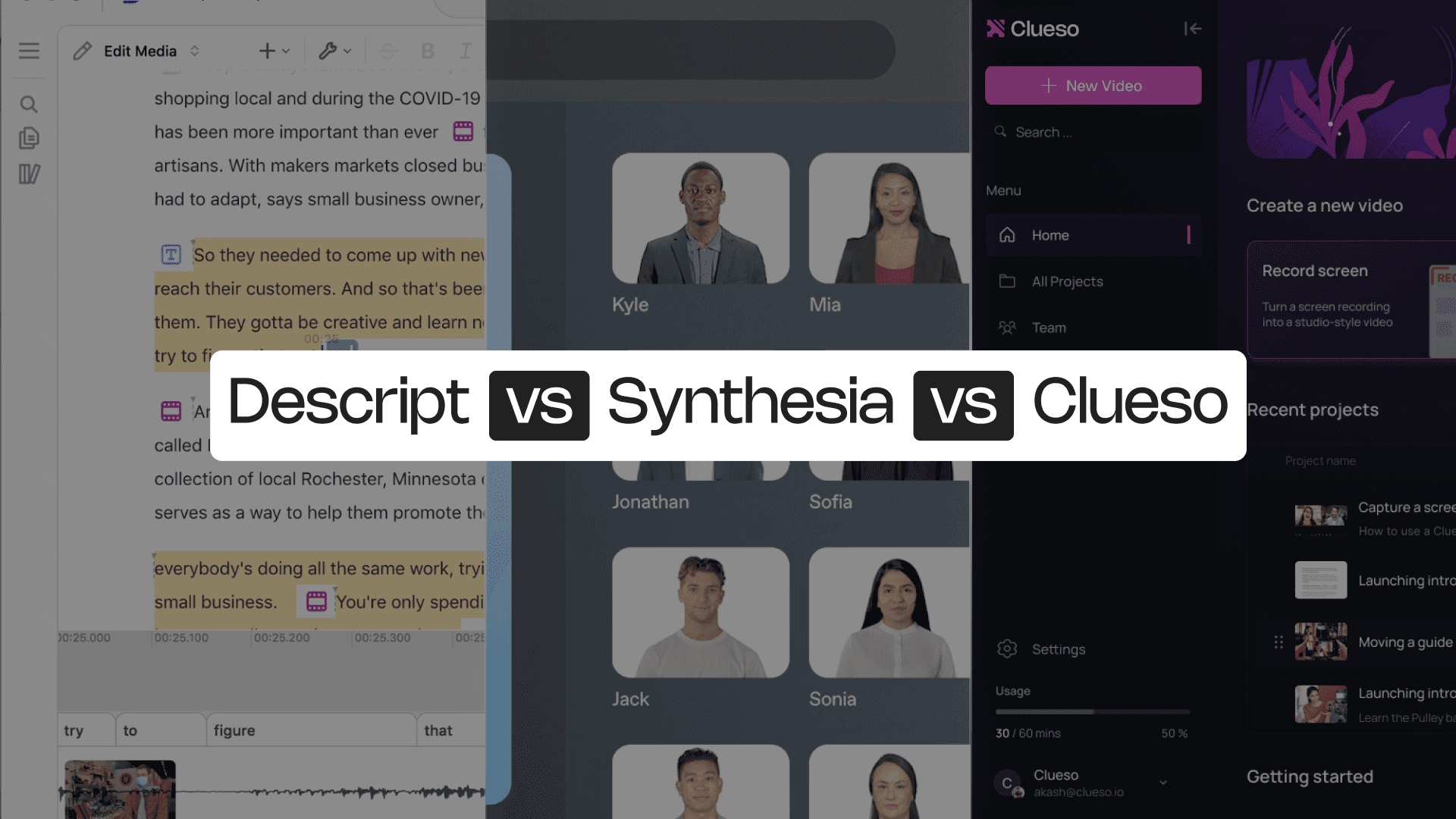
Descript vs Synthesia vs Clueso: 5 Reasons Why Clueso Is a Better Alternative

1. Clueso captures real product workflows

Synthesia and Descript help you produce polished communication, but neither focuses on capturing what users actually do inside your product.

Clueso records your real screen, detects every action you take, and transforms it into a structured, step-based tutorial. While Clueso offers AI avatars and transcript editing features, it focuses on capturing the product experience exactly as it happens.

Feature
Clueso
Descript
Synthesia
Screen Recording
Basic
Basic
Step Detection
Automatic


2. AI-enhanced editing removes manual video work

Descript simplifies narration, and Synthesia automates avatar delivery — but neither automates editing for product tutorials.

Clueso uses AI to rewrite scripts, generate AI voiceovers, remove filler words, automatically apply zooms, spotlights, callouts, audio cleanup, and 1-click translations. There’s no timeline, no layers, no manual trimming. It produces polished instructional content with minimal effort.

Feature
Clueso
Descript
Synthesia
Video Editing
Automated
Manual
AI-enhanced
Automatic Script Generation
AI Voiceover
AI Dubbing
AI Voice & Audio Sync
Manual
Manual
Auto Zooms & Highlights
Limited
Filler Removal
Limited
Background Music
Screenshots
GIFs

3. Dual output: A polished video and a step-by-step article

Synthesia produces videos only. Descript produces videos with editable transcripts.

Clueso produces two assets at the same time - a fully edited video and a structured article based on the steps captured. This gives teams everything they need for help centers, onboarding, training, and internal documentation.

Output Type
Clueso
Synthesia
Descript
Video Output
Step-by-Step Article
Video + Article Sync

4. Update content without re-recording or re-rendering

Synthesia requires regenerating the entire video to reflect updates. Descript requires re-recording or heavy editing when content changes.

Clueso lets you update just one step, rewrite text, or adjust narration without starting from scratch. It updates automatically in both the video and the article. It is perfect for fast-moving product teams.

Feature
Clueso
Synthesia
Descript
Update Without Re-recording
Auto Sync Across Assets

5. Multi-format exporting + help-center-ready publishing

Synthesia exports videos only. Descript exports videos + transcripts.

Clueso exports videos, GIFs, HTML, Markdown, and Rich Text and supports direct publishing to help centers. This makes it a true documentation tool.

Synthesia is great for polished avatar videos. Descript is powerful for narration-heavy editing. But Clueso is built for teams that need accurate, editable, and scalable product documentation: real screens, real steps, real updates, delivered in both video and written format.

You’re in good company

From start-ups to enterprises, teams of all sizes trust Clueso.

Descript vs Synthesia: Which One Is for You?

Synthesia is best for teams that want polished videos without the need for cameras or recording equipment. It excels in delivering training announcements, onboarding messages, and corporate explainers with consistent, professional AI presenters.

Descript, on the other hand, is ideal for teams producing narration-heavy content — podcasts, interviews, talking-head videos, and script-driven explainers. Its transcript-based editing makes revisions incredibly fast, especially when the voiceover is the primary focus of the content.

But when you need to demonstrate real workflows, document multi-step processes, or create content that evolves alongside a fast-moving product, these tools aren’t enough. Neither platform captures your actual interface, structures steps automatically, or generates documentation in multiple formats.

Clueso captures real screens, understands every step, enhances the recording with AI, and outputs both a polished video and a step-by-step article. And when something changes, updates are quick and easy. It’s the only platform that turns real product interactions into scalable, updatable documentation in minutes.

Experience it yourself

Experience it yourself

Frequently Asked Questions

What’s the main difference between Synthesia and Descript?

Synthesia creates AI avatar–led videos from scripts. It’s ideal for training, onboarding, and corporate announcements. Descript is a transcript-first editor, letting you edit videos by editing text — great for podcasts, talking-head videos, and narration-driven explainers.

What’s the main difference between Synthesia and Descript?

Synthesia creates AI avatar–led videos from scripts. It’s ideal for training, onboarding, and corporate announcements. Descript is a transcript-first editor, letting you edit videos by editing text — great for podcasts, talking-head videos, and narration-driven explainers.

What’s the main difference between Synthesia and Descript?

Synthesia creates AI avatar–led videos from scripts. It’s ideal for training, onboarding, and corporate announcements. Descript is a transcript-first editor, letting you edit videos by editing text — great for podcasts, talking-head videos, and narration-driven explainers.

Which tool is better for creating product tutorials?

Neither Synthesia nor Descript is purpose-built for product tutorials. Synthesia focuses on scripted avatar delivery. Descript focuses on narration and transcript editing. For real workflow demos, Clueso is the better fit.

Which tool is better for creating product tutorials?

Neither Synthesia nor Descript is purpose-built for product tutorials. Synthesia focuses on scripted avatar delivery. Descript focuses on narration and transcript editing. For real workflow demos, Clueso is the better fit.

Which tool is better for creating product tutorials?

Neither Synthesia nor Descript is purpose-built for product tutorials. Synthesia focuses on scripted avatar delivery. Descript focuses on narration and transcript editing. For real workflow demos, Clueso is the better fit.

Does either Synthesia or Descript support step-by-step documentation?

No. Synthesia generates only video. Descript provides a transcript with the video, but not structured steps or articles. Clueso automatically generates both a video tutorial and a step-by-step guide from the same recording.

Does either Synthesia or Descript support step-by-step documentation?

No. Synthesia generates only video. Descript provides a transcript with the video, but not structured steps or articles. Clueso automatically generates both a video tutorial and a step-by-step guide from the same recording.

Does either Synthesia or Descript support step-by-step documentation?

No. Synthesia generates only video. Descript provides a transcript with the video, but not structured steps or articles. Clueso automatically generates both a video tutorial and a step-by-step guide from the same recording.

Can I update content easily in Clueso?

Yes. You can update individual steps, narration, or text without re-recording the entire tutorial. Updates automatically sync across the video and article, making it ideal for evolving products.

Can I update content easily in Clueso?

Yes. You can update individual steps, narration, or text without re-recording the entire tutorial. Updates automatically sync across the video and article, making it ideal for evolving products.

Can I update content easily in Clueso?

Yes. You can update individual steps, narration, or text without re-recording the entire tutorial. Updates automatically sync across the video and article, making it ideal for evolving products.